O'ahu has a reputation problem. The island's name conjures Waikiki — the two-mile strip of hotels, surf shops and matching sunburn — and for many travellers that is where O'ahu begins and ends. This is a considerable waste of one of the Pacific's most layered and historically significant islands.
For the seasoned traveller, O'ahu offers something that its postcard image conceals entirely: a place of genuine historical weight, extraordinary natural drama and a cultural complexity that rewards curiosity far more than a week on a sun lounger ever could.
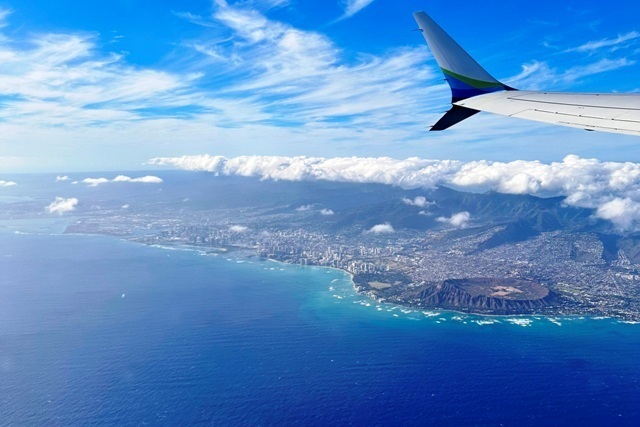
O'ahu from above — the contrast between the reef, the hotels and the mountains beyond
Honolulu: More Than a Gateway
Most visitors pass through Honolulu en route to the beach. This is a mistake. The city has a genuine cultural life that its resort reputation entirely obscures.
The Bishop Museum is the finest Pacific cultural institution in the world. Its collection of Hawaiian and Polynesian artefacts — feathered cloaks, navigational tools, royal regalia — tells the story of one of history's great seafaring civilisations with scholarship and reverence. Allow a full morning. The planetarium, which charts Polynesian celestial navigation, is outstanding.
The Honolulu Museum of Art holds a collection of Asian and Pacific art that would be remarkable in any city; in a mid-Pacific island it is extraordinary. The central courtyard, with its fountain and tropical plantings, is one of the most civilised places to spend an hour in the state.
Chinatown, a ten-minute walk from the museum, is O'ahu's most authentically lived neighbourhood — lei shops, dim sum restaurants open from dawn, herb dispensaries and a farmers' market on Saturday mornings that reflects the island's genuine agricultural diversity. Arrive hungry.
Diamond Head: The Early Riser's Reward
Diamond Head — the volcanic tuff cone that defines Honolulu's eastern skyline — is one of O'ahu's most visited attractions. It is also one of its most rewarding, provided you approach it correctly.
The crater trail is 1.6 miles return, with a total ascent of about 180 metres. It involves staircases, a narrow tunnel and a final spiral staircase to the summit observation point. The views from the top — across Waikiki to downtown Honolulu in one direction and along the wild southeastern coastline in the other — are worth every step.
The essential rule: arrive at or before 7am. The car park has limited spaces, the trail becomes extremely crowded by mid-morning, and the light at dawn is considerably more beautiful than the harsh midday sun. Bring water, wear comfortable shoes and book your entry online in advance — walk-in spots are limited.
The crater itself, formed some 300,000 years ago and last active around 150,000 years ago, was fortified by the US military in the early twentieth century. The concrete bunkers and tunnels you pass through on the way to the summit are part of Fort Ruger, built during the First World War and expanded after Pearl Harbour. The military history and the geological drama make for an unexpectedly layered experience.
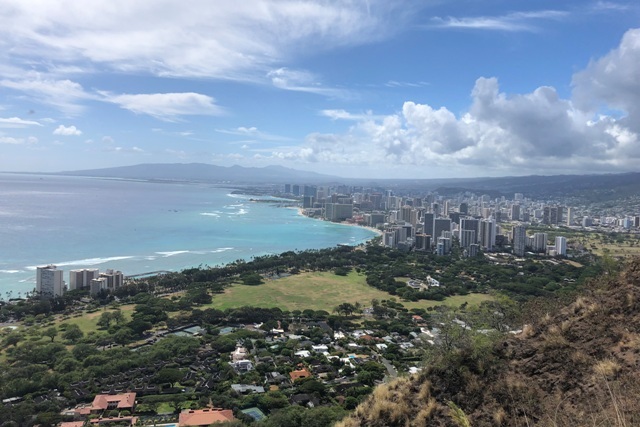
The summit view in the afternoon — Waikiki's towers and the ocean beyond
Pearl Harbour: A Morning of Reflection
The attack on Pearl Harbour on 7 December 1941 — the event that brought the United States into the Second World War — remains one of the defining moments of twentieth-century history. The memorials on the western shore of O'ahu treat it with the gravity it deserves.
The USS Arizona Memorial, which spans the sunken hull of the battleship that claimed 1,177 lives in the attack, is reached by a short boat ride from the visitor centre. The structure — white, arching, with an open centre section — was designed by Alfred Preis, an Austrian architect who had himself been interned as an enemy alien after Pearl Harbour. The oil that still seeps from the wreck, visible as iridescent slicks on the water's surface, is referred to by the site's staff as the "tears of the Arizona." Standing above the ship, still a commissioned US Navy vessel, is a genuinely affecting experience.
The Battleship Missouri Memorial, where the Japanese surrender was signed in September 1945, provides a different kind of historical bookend. The ship is enormous — walking its decks takes the better part of two hours — and the surrender plaque on the deck where the ceremony took place is marked with quiet simplicity.
Practical notes: book the USS Arizona boat tour well in advance — it sells out weeks ahead, particularly in summer. Bags are not permitted on the boat; lockers are available at the visitor centre. The entire site requires a half-day minimum; a full day is not excessive if you include the Missouri and the Pacific Aviation Museum.
Dole Plantation: History Behind the Souvenir Shop
The Dole Plantation, in the central plain of O'ahu near Wahiawa, tends to be dismissed by more serious travellers as a tourist trap — which it partly is. The pineapple maze, the gift shop, the Pineapple Express train: these are not the reasons to go.
The reason to go is the story it tells about O'ahu's economic and social history. James Dole arrived in Hawai'i in 1899, a year after US annexation, and established the Hawaiian Pineapple Company on land that the US government had made available to American agricultural entrepreneurs. By the 1920s, Hawai'i was producing 75% of the world's pineapples. The plantation system that supported this industry shaped the island's demographics profoundly — drawing workers from Japan, the Philippines, Portugal and Puerto Rico, creating the extraordinary ethnic diversity that defines modern Hawai'i.
The plantation garden tour, which takes you through varieties of pineapple, coffee, cacao and other crops grown on O'ahu, is genuinely informative and takes about 45 minutes. The pineapple soft-serve, whatever your feelings about tourist food, is excellent.
Combine the Dole Plantation with a drive through Wahiawa itself — a working town with no particular tourist infrastructure, which is precisely what makes it interesting — and the Kukaniloko Birthstones nearby, a sacred site where Hawaiian royalty were traditionally brought to give birth, now sitting in an unremarkable field between the pineapple farms.
The Windward Coast: O'ahu Without the Crowds
Cross the Ko'olau mountains via the Pali Highway and you arrive on O'ahu's windward side — greener, wetter, quieter and considerably more beautiful than the tourist corridor on the southern shore. The Nuuanu Pali Lookout, at the top of the highway pass, offers vertiginous views down the cliffs to Kailua Bay and the patchwork of windward valleys. The wind at the lookout is extraordinary — strong enough, on gusty days, to make standing upright a minor athletic achievement.
Kailua is the windward coast's main town — a genuinely pleasant, walkable place with good coffee, independent bookshops and a beach that many locals consider the finest on the island. Kailua Beach is long, white, sheltered and backed by ironwood trees; the kayaking to the Mokulua Islands offshore is excellent.
Practical Notes for the Unhurried Visitor
- Getting around: A hire car is essentially necessary for anything beyond Waikiki. O'ahu's bus system (TheBus) is comprehensive but slow — the Dole Plantation and Pearl Harbour are both reachable by bus, but journeys take twice as long as driving
- Best months: April–May and September–October offer the best balance of good weather and manageable visitor numbers. December and January bring some rain but also the spectacular North Shore surf season
- Where to stay: Waikiki is convenient but characterless at the hotel level. Kailua on the windward coast or the North Shore near Haleiwa offer considerably more authentic experiences, at the cost of a longer drive to Pearl Harbour and Diamond Head
- Booking ahead: USS Arizona Memorial boat tours, Diamond Head entry permits and Honolulu Museum of Art visits should all be booked before you arrive. Popular slots fill weeks in advance
- Respect: Pearl Harbour is a military cemetery. The USS Arizona contains the remains of more than 900 sailors who were never recovered. Dress respectfully and follow the site's guidelines without exception
Affiliate links — we earn a small commission if you book, at no extra cost to you.